

 Australia's No.1 Managed Service Provider for Quality, Value and Service
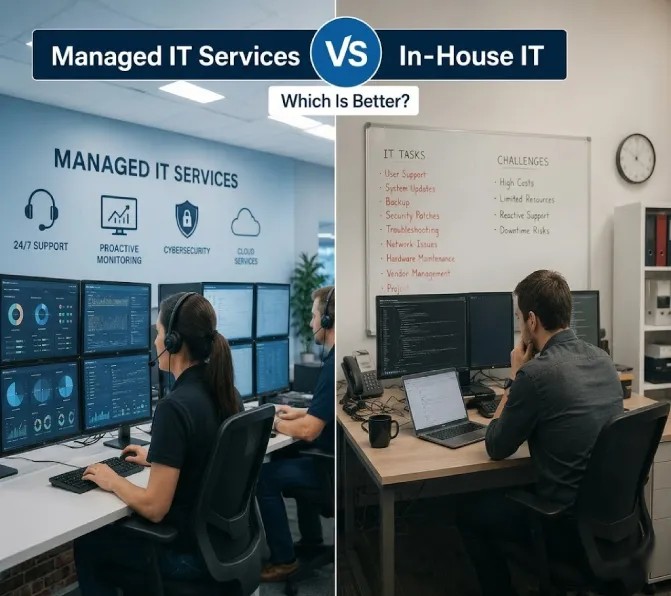
Managed IT Services vs In-House IT: Which Is Better?
Technology has become a critical driver of business success. From supporting daily operations and enabling remote collaboration to protecting sensitive data, your IT environment influences productivity, efficiency, and long-term growth. As technology becomes more complex, businesses face an important decision: should they rely on an internal IT team or partner with an external technology provider?
When comparing Managed IT Services vs In-House IT, there isn’t a one-size-fits-all answer. The right approach depends on your organisation’s size, budget, security requirements, and growth strategy. While some businesses benefit from maintaining an internal IT department, many are choosing outsourced IT solutions to gain specialist expertise, improve cybersecurity, and reduce operational costs.
This guide compares both approaches to help you determine which model best supports your business.
What Is Managed IT Service?
Managed IT Services involve outsourcing the day-to-day management of your technology infrastructure to a managed service provider (MSP). Instead of waiting for systems to fail, the provider proactively monitors your environment, applies software updates, resolves technical issues, and strengthens security before problems impact your business.
Typical services include:
- 24/7 infrastructure monitoring
- Remote and onsite technical support
- Network and server management
- Cloud infrastructure management
- Microsoft 365 administration
- Backup and disaster recovery
- Cybersecurity protection
- Strategic IT consulting
- Software updates and patch management
This proactive approach helps businesses minimise downtime, improve system reliability, and maintain a secure technology environment without the overhead of managing everything internally.
How an Internal IT Team Operates?
An in-house IT team consists of employees who manage an organisation’s technology internally. Their responsibilities often include user support, hardware maintenance, network administration, software deployment, and resolving day-to-day technical issues.
For larger organisations with complex environments, an internal IT department can provide valuable knowledge of business processes and immediate onsite assistance. However, maintaining an internal team requires significant investment in recruitment, salaries, ongoing training, specialised software, and infrastructure.
As technology evolves, businesses may also need additional specialists in cybersecurity, cloud computing, compliance, and business continuity, increasing both complexity and operating costs.
Managed IT Services vs In-House IT: Key Differences
Choosing between outsourced IT support and an internal team involves more than comparing costs. Factors such as expertise, scalability, cybersecurity, availability, and long-term business value should all be considered.
| Feature | Managed IT Services | In-House IT |
|---|---|---|
| Cost | Predictable monthly pricing with no recruitment or training costs. | High costs for salaries, recruitment, training, benefits, and IT tools. |
| Technical Expertise | Access to a team of specialists across networking, cloud, cybersecurity, Microsoft 365, and infrastructure. | Limited to the skills and experience of the internal team. |
| Cybersecurity | 24/7 monitoring, threat detection, vulnerability management, and proactive protection. | Often limited by available resources and specialised expertise. |
| Scalability | Easily scales as your business grows without hiring additional staff. | Requires recruiting and onboarding more employees as IT demands increase. |
| Availability | Continuous monitoring with remote support and proactive maintenance. | Typically available only during business hours unless additional staff are employed. |
| Technology Access | Access to the latest tools, automation, cloud platforms, and enterprise technologies. | Technology adoption depends on internal budgets and staff expertise. |
| Business Continuity | Built-in backup, disaster recovery, and continuity planning. | Requires significant investment to build equivalent capabilities internally. |
| Response Time | Fast response backed by monitoring and dedicated support teams. | Response depends on staff availability and workload. |
| Control | Shared management with regular reporting and strategic guidance. | Complete internal control over IT systems and processes. |
| Business Knowledge | Learns your business over time while following documented processes. | Deep understanding of internal workflows and company culture. |
| Flexibility | Access to a wide range of expertise and services whenever required. | Limited by team size, experience, and available resources. |
| Overall Value | Delivers proactive support, expert knowledge, stronger security, and predictable costs. | Better suited for organisations with large budgets and highly specialised internal requirements. |
Why Businesses Choose Outsourced IT Support
Many organisations are moving away from the traditional break-fix model and adopting proactive technology management because it offers significant operational advantages.
Key benefits include:
- Predictable monthly IT costs
- Reduced system downtime
- Access to experienced technology specialists
- Stronger cybersecurity protection
- Continuous infrastructure monitoring
- Improved business continuity
- Faster issue resolution
- Easy scalability as the business grows
- Access to strategic technology advice
Rather than hiring multiple specialists internally, businesses gain access to a complete team with expertise across networking, cloud platforms, cybersecurity, Microsoft technologies, and infrastructure management.
Benefits of an In-House IT Team
An internal IT department can still be the right choice for some organisations, particularly larger enterprises with complex infrastructure or highly specialised operational requirements.
Advantages include:
- Immediate onsite support
- Familiarity with internal business systems
- Direct communication with employees
- Greater control over technology decisions
- Close collaboration with other departments
However, maintaining these capabilities often requires substantial investment in people, technology, and ongoing professional development.
When a Hybrid IT Model Makes Sense
Many businesses no longer choose between one model or the other. Instead, they adopt a hybrid approach by combining an internal IT team with outsourced support.
In this model, internal staff manage strategic business initiatives while an external technology partner provides proactive monitoring, cybersecurity management, cloud support, after-hours assistance, and specialist expertise.
This approach enables businesses to retain internal knowledge while benefiting from additional technical resources and enterprise-level support.
Signs Your Business Has Outgrown an In-House IT Team
As organisations expand, technology becomes more complex. If your internal team spends most of its time fixing problems instead of improving systems, it may be time to consider outsourcing some or all of your IT operations.
Common signs include:
- Frequent system downtime
- Increasing cybersecurity concerns
- Slow response to technical issues
- Limited cloud expertise
- Difficulty supporting remote employees
- Rapid business growth
- Rising IT costs
- Compliance becoming more difficult to manage
Outsourcing can help relieve pressure on internal teams while providing access to additional specialists and proactive support.
Which Option Is Best for Growing Businesses?
For many small and medium-sized businesses, outsourcing day-to-day IT management provides greater value than building a large internal department.
Growing businesses often require enterprise-level cybersecurity, cloud expertise, infrastructure management, and business continuity planning without the expense of hiring multiple IT specialists. Partnering with an experienced provider allows organisations to access a broader range of expertise while maintaining predictable operating costs and reducing technology-related risks.
Larger enterprises with dedicated IT departments may continue to benefit from internal resources, particularly where specialised applications or highly customised infrastructure are involved. In many cases, a hybrid approach delivers the best balance between internal knowledge and external expertise.
Questions to Ask Before Choosing Your IT Model
Before deciding which approach is right for your business, consider the following questions:
- What is your available IT budget?
- How important is minimising downtime?
- Do you require 24/7 monitoring and support?
- Is cybersecurity a growing concern?
- Will your business expand over the next few years?
- Do you need access to specialist technical expertise?
- Are compliance requirements becoming more complex?
Answering these questions will help determine whether an internal team, outsourced support, or a hybrid approach is the most suitable option.
Ready to Simplify Your IT and Focus on Growing Your Business?
Choosing the right IT strategy is about more than solving technical issues—it’s about creating a secure, reliable, and scalable technology environment that supports your business goals. Whether you’re reviewing your current IT operations or considering outsourcing for the first time, working with an experienced technology partner can help reduce risk, improve efficiency, and position your organisation for future growth.
MSP Corporation helps businesses simplify technology management through proactive support, strategic guidance, and enterprise-grade security solutions tailored to their operational requirements. If you’re ready to explore how Managed IT Services can improve business performance, call 1300 554 404 or email [email protected] to speak with our team.